Showing posts with label place. Show all posts

September 18, 2011

A walk in the park (with spatial matters on the brain)

Over the past year or so I have been reading a lot more work that focuses on issues such as space, place, and nature.  More anthropologists have been looking into these issues in the past ten years.  Setha Low and Teresa Caldeira are two really good examples.  I have also been reading a lot of work by geographers--Neil Smith, Henri Lefebvre, Edward Soja, Doreen Massey, and others.  Soja argues that while many researchers in the social sciences and humanities take consideration of things like culture and history as fundamental, they often neglect concerns about space.  This is an important point.  Regardless, the more I read along these lines, the more it infects my thinking.  This is a good thing.  Take, for example, this set of images.  They were taken during a recent walk in a nearby park, when I was working on some geographical readings.  Parks are pretty fascinating places.  People go to them to experience "nature," but it's a very ordered, constructed, bounded, manicured, and ultimately human induced sort of nature.  We like to make "nature," in essence, with our gardens, walls, pathways, and such.  Anyway, here's a few of those images, with some captions for good measure.

This one is technically on the way to the park, but the strange spatial matters are already apparent.  Grass plays an interesting role in our landscaping and understanding of nature.  This is the theme that runs through all of these images.  Grass is everywhere, but it's very much shaped by our ideas and actions.  What I like most about this one is the fact that the grass is clearly creeping it's way back across the sidewalk.  Nature requires constant attention to keep it looking pretty and in check--otherwise it runs rampant and we might lose our way.

Here is where the flower garden ends, cut into an unmistakable corner to separate the planted area from the surrounding field of grass.  What is most striking is how geometric this is, and how it reflects an explicit way of thinking about and arranging space.  The flowers go here.  And the planter ends, here.  Notice, once again, the invading weeds that seek to undermine all of these great designs.

We often think about what we can see on the surface, not what exists below.  Imagine all of the roots and passageways that exist below places like this.  This image is particularly Deleuzian/Guattarian for me, and I am not trying to be obtuse.  Deleuze and Guattari talked a lot about rhizomes, and this image is a fascinating example of a human induced rhizomatic system that runs underneath the leisurely and "natural" park system.  These two metal covers are just a hint of what lies below.
Another curving pathway, with trees places in pleasing locations alongside the path.  Here is a clear division between where the pedestrian is supposed to walk and where most do not.  But some cross the threshold and march across the grass.  Why?  What makes someone want to wander around through the grass?  Better yet, what makes the vast majority of people follow the pre-planned asphalt path?  Why, when faced with this situation, do many of us simply go along with the order and routine of the space?

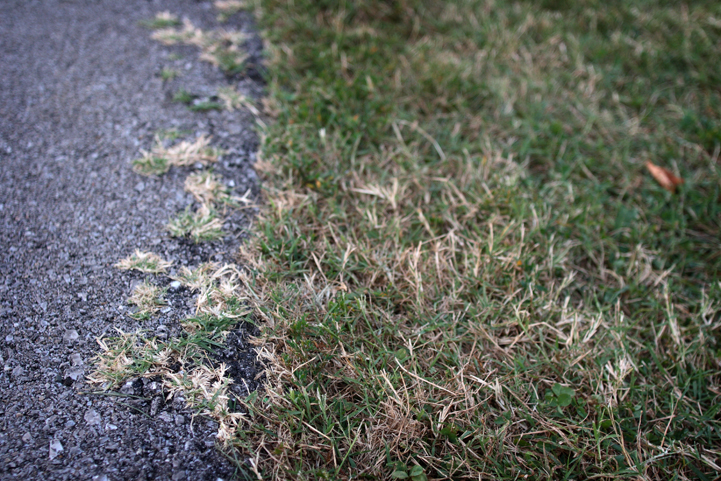
We often think that there are clear boundaries between nature and non-nature.  But look closely at the edge of this walkway--one bleeds into another, and the division isn't even static.  The grass keeps pushing and growing, and has to be beaten back by machines with spinning blades and such.  The battle to define and bound nature is endless, and violent.  No matter...the asphalt keeps cracking, and the grass will probably win out eventually.  Regardless, both are products of human intervention.

I am not going to say a lot about this one because if you look at it in a certain way it speaks for itself.  This is a clearly defined space for "being in nature."  Fascinating.  The concrete pad is the best part.  Sit here to view nature.


I am going to end with this one, which shows how intertwined humans are with the environments they produce.  These places reflect ideas about space and the so-called natural world, and they are also places full of memories.  Parks are often marked with memorials like this, so that new people who pass through can remember others who came before them.  Notice, once again, the role that the grass plays in all of this.  It not only frames the tree, it also rings the marker itself.  Gardeners have to work to maintain this aesthetic segregation.

Cross-Posted at Plurality Press.

June 26, 2011

The lives (and meanings) of tourist spaces

I have always been pretty fascinated by the life histories of tourism destinations. Thinking about touristic spaces in a kind of archaeological sense--that is, over greater periods of time--is endlessly fascinating. I often wonder about the future of places like Las Vegas, Cancun, and Nakheel, especially since many international organizations (like the UNWTO) promote tourism development as a sustainable, surefire solution for socio-economic development. What will Vegas--or Cancun--look like in 100 years? What purpose will these places serve, and how sustainable will they actually be in the long run?

Many countries around the world continue to promote and finance ever more tourism development, in hopes that these investments will create long-lasting social and economic benefits. At least, that's how the narrative goes. But what kinds of social spaces and places are being created under the guise of tourism, and what futures do these places face? What are the lasting social, political, and economic effects of these spaces? For a little insight, I am going to discuss a few tourist destinations that I have read about recently: Elmina, Ghana, Prora, Germany, and finally Acapulco, Mexico.

Edward Bruner's writes about Elmina Castle in Ghana in his wonderful book Culture on Tour (2005). His discussion, which is in chapter three, brings up some poignant issues, one of them being that any tourist location has a multiplicity of histories and meanings. Bruner focuses on how African-American tourists travel to Elmina to experience a connection with their shared understandings of heritage and history. The irony of the chapter, however, is that the local Ghanaians do not share the same understandings about the castle itself. While the American tourists come to see the castle as a brutal representation of the transatlantic slave trade, the Ghanaians have a much broader conception of the same place. For many African American US tourists, "the castles are a sacred ground not to be desecrated. They do not want the castles to be made beautiful or to be whitewashed...Some diaspora Blacks feel that even though they are not Ghanaians, the castles belong to them" (Bruner 2005:103).

January 9, 2011

Demarcated Places: Old Town, SD


Another photo from Old Town in San Diego. Interesting to see how particular spaces/places are mapped out and demarcated in very overt ways...like with plaques. This plaque, attached to a large rock, marks this place as "The End of the Kearney Trail, December 12, 1846." This was put in place by the San Diego Chapter of the Daughters of the American Revolution in 1920.

January 7, 2011

Things, people, and places


Over the break I have been reading some extra things here and there--a book about reassembling the social by Bruno Latour, another about value by David Graeber. And also some books, articles, and other bits and pieces about place and space (Setha Low, David Harvey, etc). So these issues and themes are somewhat stuck in my mind right now. That's how it all works, right?

The table above is in Old Town San Diego, a place that I have walked through numerous times in years past. Latour argues that we need to think about the ways in which object--things--are part of social relationships, and I think the bench above is a good example. Think of the number of people who pass through this place, and who use this particular arrangement of material (wood, nails, and so on) and space (grass, benches, table) for certain purposes. Maybe people use this bench for a family lunch--or maybe homeless people use it as a safe place to sleep for a while (that all depends on the presence of law enforcement though). We make certain things, and order certain spaces, to conform to our ideas about what it means to be social. But our actions are not simply the result of ideas--they are also shaped by material forms like benches, gates, walkways, grassy areas in parks. And it's an ongoing process--ideas shape places, places then shape ideas and actions, and so on.

The table pictured above is a reflection of a massive flood of ideas, histories, and social patterns. It's a purposefully designed artifact, made for a "public place" to provide a space for a range of activities. Of course, some are more acceptable than others, and the regulation of those activities comes about either through the intervention of the legal order (police tell people not to sleep in parks) or through more informal means. Overall, though, there is really no way to completely determine or control how people use spaces--no matter how much enforcement or surveillance is out there. There will always be a certain amount of slippage. Sure, some will use this table "the right way" by eating a nice lunch or reading a book, but others won't. To me, the edges of these sorts of social behaviors are pretty fascinating. And along these edges there are a whole range of material objects that play a key role in "social" relationships.

November 21, 2010

And sometimes I ask myself...how did these people get here?


From my readings about different approaches to the study of tourism: "As Franklin...argues, tourism is no doubt a social activity, but it cannot be reduced to the social because it is relationally linked to a wide variety of objects, machines, texts, systems, non-humans, spaces and so on, without which it would not happen and could not become what it is: 'as an ordering it organizes a complex mesh of human and non-humans and creates ordering effects" (Rene van der Duim, 2007: "Tourism, Materiality and Space"). The photo above was taken at the archaeological site of Coba in 2008. What guidebooks, stories from friends, TV shows, airline offers, understandings of the world, educations, vacations, social networks, industries, chance occurrences, and other factors came together to bring these people to this place, at that time, atop some old pile of rocks? What motivated those people to go THERE, of all places? What beliefs? What economic factors? What matters of taste? What historical interests? What biases? What discourses have come together to create Coba as a desirable destination, as a place worthy of spending income on to visit? What happens when those discourses change--when Coba is no longer seen as a valuable place? Does it just become another old pile of rocks, as it was before being resurrected by the tourism industry (and archaeologists, of course)?