Showing posts with label Savage Minds. Show all posts

September 16, 2012

Finding value: Theory, abstraction, and fieldwork

I am still obsessed with the concept of value.  What is value?  What does it mean to say something has value?  How do we decide what something is “worth”?  How are different ideas about value connected to meaning–and action?  How do our ideas about value, worth, and meaning relate to our actions?  How is value connected to money (in its various forms)?  How are different forms of valorization (economic, cultural, moral, political) connected?  Where and when are they disconnected?

When I started on this exploration of the idea of value, one of my friends told me that if I’m really serious about looking deeper, then I should start with David Graeber’s book on the subject.  I did, and have subsequently read that book–and his book about Debt–and taken tons of notes.  My friend also said that my search for the meaning of value is going to head back to Marx one way or another.  And it did.  But it also led to Adam Smith, Clyde Kluckhohn, David Harvey, Noel Castree, Julia Elyachar, and many others.  This search for value has led me down many different side streets and avenues, and there’s still a lot of ground to cover. The most recent book that I am reading is James Buchan’s book Frozen Desire.  The money/value question, especially as it relates to land, real estate speculation, and development, is what has been keeping me occupied for some time now.  The more I look into value, the more I want to keep looking.  It’s a bit like an endless economic rabbit hole.

Now, I am definitely fascinated with the idea of value, but I am also willing to admit that it’s a massive, if not vague, concept.  Graeber said pretty much the same thing in the beginning of his book.  The word “value” can refer to a range of things: from prices and money values all the way to moral values.  So there’s a bit of fuzziness and abstraction going on, simply because of the wide array of ways in which people use the term.  Sometimes it’s hard to tell when one usage ends and another begins.  There’s a lot of contradiction and overlap going on.  I hate to say it, but the whole idea of value gets complicated–and really, really abstract at times.  Maybe too abstract?

Read the rest on Savage Minds.

July 10, 2012

Speaking of open access...


The subject of open access publishing gets a fair amount of press around here at Savage Minds. For good reason, in my opinion, because the publishing regime that we currently have needs a little…rethinking.  Going “open access” is, of course, one possible option.  But what is this open access thing really all about?  If we’re going to consider OA, it’s probably a good idea to look deeper into the issues involved.  It’s definitely not some magical thing that will just happen overnight.  It will take work, planning, and cooperation among lots of people.  Anyway, here are some sources to look  into regarding anthropology and open access:*

First, check out Peter Suber’s overview of OA for starters.  Learn it.  Live it.  Know it.

Next, Wikipedia (fittingly) has a pretty nice overview of what OA is all about, including some of the debates about financing, etc.  The OA page is here.

Also, check out the three interviews I did with Jason Baird Jackson about Open Access and anthropology a while back.  Jason is a wealth of information when it comes to all things OA (have a look at his site too).  The first of the OA interviews with Jason is here.

Financing is one issue that comes up a lot, and rightfully so.  For a few ideas, have a look at Kim and Mike Fortun’s “thought experiment” about Liberating Cultural Anthropology.

More good stuff: the OA archives link here at Savage Minds.  You don’t have to go far to start reading about OA.

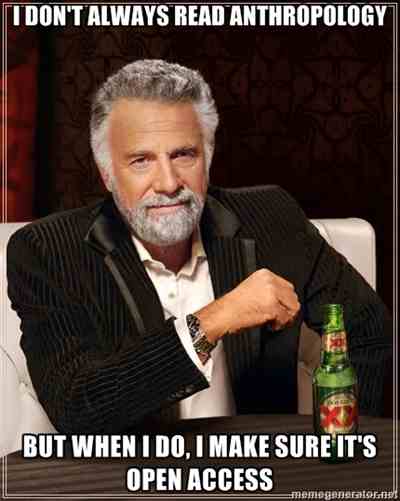
Finally, I’m adding this simply because I can’t help myself:


*If you have other OA sources and links, please feel free to post them in the comments section.

December 14, 2011

Bureaucracies & the power of nonsense

For some reason, I am feeling decidedly anti-bureaucracy today.  Does this ever happen to you?  What is it about bureaucracy that it is so difficult, that drives us mad?  Let me give an obvious answer that you would expect from some cultural anthropology type like myself: it's because of the inhumanity of it all.  The inhumanity of some bureaucracies can become so thick that they turn us all into blithering fools.

We get backed into a corner, with no place to turn.  Our choices are cut off--we are stuck with the hassles of lines, rules, and forms.  We wait on phones, we try to find official offices with no address.  You know what I'm talking about.  We become not just fools in this process, but blithering fools.  But there is power in the inefficiency of bureaucracies--Weber knew that, as did many others.  You know that too, don't you?  If you want to know more about this, please click here for more options.

Apologies for that...there must be some sort of glitch in the system.  I will send out a request for someone to post a note about composing an email to resolve this issue at a later date.  Please wait.  In the mean time, if you haven't read David Graeber's "Beyond power/knowledge: an exploration of the relation of power, ignorance and stupidity," well, you should.  Here is your chance.

Let me give you a short example of the hilarity of bureaucracy from some of my recent travel experiences:
 
Read the rest on Savage Minds.

November 11, 2011

Anthropology & Open Access: An Interview with Jason Baird Jackson (Part 2 of 3)

See Part 1 of this interview here.

Ryan Anderson: So what are the major stumbling blocks holding up a transition to Open Access in your view? What's keeping most people from making this jump? Lastly, what do you think about the system employed by the Social Science Research Network (SSRN) where authors can post working papers? Can a system like that be a stepping stone to OA?

Jason Baird Jackson: At the author level, one stumbling block is a pervasive lack of basic knowledge about these issues among scholars and policy makers within our field (and in most fields). I am sympathetic to everyone’s plight. It is all very complicated and uncertain therefore doing what we have always done has proven the easiest path. Most of us do not understand copyright or the Creative Commons system. Most of us do not understand journal business models or how it is that librarians have made so much (expensive) information so easily available to those of us with the luxury of university affiliations. In the face of much confusion and anxiety, just sending our manuscripts to the editors and journals that we know in the way that we have always done has seemed sensible and prudent.

Related is the situation in which we perceive that we understand the changing landscape better than we do. A clear instance is when we post the final published versions of our writings online because we wrongly believe ourselves to have the right to do so. The increasing prevalence of such accidental piracy fosters the misunderstanding that such practices are the right way to do open access. Such piracy is counter-productive on many levels and is unnecessary given that there are legal and technically better ways to pursue OA.

Such author-centered issues are the major stumbling block for green OA. The fact that many scholars do not have direct access to a home institutional repository is another factor. I tried to suggest that there are usually workarounds for this in my earlier comments. Your mentioning of the Social Science Research Network represents another possible solution that anthropologists should investigate more actively [see Adam Leeds' comment about SSRN here on Savage Minds a while back]. I have not yet given it the attention that it deserves as a possible option for anthropologists.

The biggest factor driving green OA are funder and especially institutional OA mandates (touched upon above). Those who are most eager to promote OA in anthropology can work locally to establish mandates in their home institutions. When a university such as Kansas or California or a college such as Oberlin, or when (hypothetically) a research institute, applied anthropology agency or museum, establish a green OA mandate, this has the almost immediate effect of educating the entire research community at such an institution about the issues that we have been talking about, above and beyond the obvious direct benefit of bringing a large portion of that institution’s research output into the OA domain. Such mandates can be established at the school or department level in instances where an institution-wide mandate cannot yet be achieved. The most prominent and persistent advocate for green OA and for green OA mandates is cognitive scientist Steven Harnad, who makes the case consistently and forcefully, on the basis of much evidence, at his website Open Access Archivangelism.

Read the rest on Savage Minds, here.

November 7, 2011

Anthropology & Open Access: An Interview with Jason Baird Jackson (Savage Minds)

During the last few weeks I had the chance to conduct an email based interview with Jason Baird Jackson about Open Access (OA), academic publishing, and anthropology (cross-posted on Savage Minds)...

Ryan Anderson: Thanks for doing this interview, Jason. My first question is really basic: What IS open access all about, and how is it any different from standard academic publishing?

Jason Baird Jackson: Its a pleasure to have this chance to talk about open access (hereafter, OA). When I am asked to recommend an explanation of what OA is about, I usually point colleagues to the basic introductory documents assembled by philosopher and OA strategist Peter Suber. His one page "Very Brief Introduction to Open Access" is a great place to start. It begins noting: "Open-access (OA) literature is digital, online, free of charge, and free of most copyright and licensing restrictions. What makes it possible is the internet and the consent of the author or copyright-holder." There is much more that scholarly authors, societies, publishers, and libraries need to know about OA, but this is a good start. The features that Suber notes in this sentence comprise the basic differences that you are searching for.

OA evokes different things for different people and interest groups. I suspect that we will touch on some of the range of concerns that these actors bring to the topic. For a time, it made sense to speak of OA as an alternative to standard academic publishing but I do not think that this framing works any longer. While OA represents a significant set of transformations in what we might think of as the inherited scholarly publishing domain, OA is now at the heart of standard academic publishing. That does not mean that there is agreement about the issues or about emergent practices or even about the definition of basic terms. My "its all one system now" view just acknowledges such facts on the ground as the reality that we now have academic authors publishing in "gold OA" journals without even realizing that such a nameable kind of publication exists as such. On the other side of the ledger, the largest commercial publishers are fully, if sometimes begrudgingly, involved in open access through their having acceded to public, university, and funder demands for what is called "green OA" and via their author-pays approaches to gold and "hybrid” OA". (We'll touch on these modes, perhaps.) While people like me tend to talk about OA as a means towards a dramatic transformation of scholarly communication, one aimed at making it more sustainable, accountable, ethical, public, etc., commercial publishers increasingly describe OA as just another business model. We are debating and rebuilding the same publishing system even if, at times, and in some senses, it seems like OA advocates are creating an alternative infrastructure for the discovery, circulation, evaluation, and reuse of scholarly research outputs.

It can be treated as a different topic, one that we need only acknowledge and not discuss, but I just used the terribly clumsy phrase "research outputs" as a way of highlighting the parallel transformations that we are experiencing in the system of scholarly genres. Running alongside the OA transformation, the canonical genres—journal article and scholarly book—are being remixed and destabilized in countless ways. For anthropology, these generic changes are different from those that followed the field's "writing culture" debates. Earlier, we wondered what we could say in a book. Now we wonder what a book is. In your own corner of the new territory, I could ask: Is your anthropologies project a journal, a scholarly website, a weblog? Do your authors know? Such questions are increasingly present and point to what a time of experimentation we are in. OA advocates in anthropology have been particularly attentive to this related-but-not-the-same issue of genre. That said, the core of the OA discussion has been the journal article as we've known it and few would deny its continued centrality as the currency of the academic realm.

September 7, 2011

Matt Thompson: "Let public anthropology be fast, cheap, and out of control."

Matt Thompson just wrote a fantastic post over at SM.  Here's the end of it:
What I’m trying to say is don’t sit around waiting for the next Margaret Mead. And anthropology doesn’t become more relevant to Jose Six-pack once we cross Marshall Sahlins with Marshall Mathers. We can all be public intellectuals of a local, non-celebrity sort. Find something where you are, some way to play a role however small and do it. It doesn’t have to be hard. You don’t have to write a grant. Just share what you know and what you do with the people around you. Let public anthropology be fast, cheap, and out of control.
 Now, go read the beginning and middle, here.

March 6, 2011

Collaboration Abounds: Savage Minds - Neuroanthropology - Middle Savagery

There's a lot of good stuff to check out lately in anthro/archaeo blogging world, that's for sure. The first stems from the idea that Rex at Savage Minds came up with a few weeks back: love letters to anthropology. Various people responded to this collaborative call--including Rex himself--and Daniel Lende put several of these together at Neuroanthropology. Definitely worth taking some time to read through...and think about how and why we're all doing this anthropology thing.

Next, Colleen Morgan posted a roundup of her "Blogging Archaeology" carnival, which is in anticipation of a session on blogging and archaeology at the 2011 SAA meetings in Sacramento (some of my friends are going to the SAAs this year, and they better go to this panel and tell me how things went). There are all kinds of reactions and opinions about the potentialities and drawbacks of using blogs as a communicative tool--or even a research tool. Some folks are more optimistic than others...but that the whole point. It's about discussion, connections, chucking ideas out there and seeing what happens.

Anyway, what I like best about this is that there are groups of people putting ideas together and making projects like this. These discussions take a form that is quite different from the presentation style of the usual "debate" in an academic journal (or even conference), in that they are bit looser, more informal, maybe a little less refined. I like these open conversations, since they show some of the process at work. Sometimes, when we're looking at finished ethnographies or archaeological monographs, it's not easy to see how the project went from the madness of fieldwork and research to the final version (which is cleaned up, edited, and presented in a very neat manner). Grace Krause from the MSU Campus Archaeology Program sums this up pretty nicely:
Much of the information and opinion expressed on blogs is transient and will never be formally published, but this does not mean there is no value in fast-paced reporting. Rather, blogging represents a missing link in the academic thought process that was rarely seen before the rising popularity of digital media. This is what is happening, this is what we’re thinking about right now as opposed to waiting months or years for an official publication, if it ever comes. Blog entries are Polaroid pictures of archaeological ideas, instant and unpolished, but nevertheless the perfect way to watch those ideas germinate and develop over time.
Maybe, after all, some of these types of discussions will make us all start rethinking the FINAL PRODUCTS as well. Who knows? What I like best of all is that I can wake up on a Sunday morning and check out what all of these people are thinking, writing, and exploring about anthropology and archaeology while I'm eating my cereal. Super cool.

September 10, 2010

SM ---> Podcast

Just a short note. Alex Golub over at Savage Minds has announced that they are going to be doing a podcast series. The first one has already been posted. I vote yes for proposition "Anthropologists should start messing with media more and doing things like podcasting." What's your vote? The link to the SM podcast series is...

HERE.

March 1, 2010

The official and the unofficial

This is interesting. David Price wrote a short review about anthropology blogs--it's pretty fascinating when two different styles of communication start referring to one another. Here is a little excerpt from Rex at Savage Minds about this:
Today I woke up to the usual quarterly flow of new journal alerts into my inbox and was surprised — delighted, really — to see a very complimentary article in the latest American Anthropologist on Savage Minds, Zero Anthropology, and the AAA blog. In another proof of its incredible capacity to do the work of our association, AnthroSource has the article behind a paywall while Wiley-Blackwell has it available for everyone to read (here is the abstract and you can download the PDF here sorry here is the actual link).
The (short) article is well worth reading. It gets me thinking about how--and why--anthropologists create information. In many ways, I find journal articles to be both extremely useful and extremely closed. I wonder how publishing models will change, or if they will change in the near future. The problem, ultimately, is about the control of information. There HAS to be some measure of control, right? Maybe.

Overall, I prefer the informal nature of blogs to a lot of what I have to read all the time. It's interesting to see people bend the rules a little, mix up the standard presentations, and even just post some things off the cuff. Here are some of the sites that I check all the time:

Zero Anthropology
Neuroanthropology
Middle Savagery
Sociological Images
Savage Minds
anthropologyworks
Archaeological Haecceities