Showing posts with label photography. Show all posts

November 18, 2011

Eating tool up close

I took this one a few years back, just found it, and am now posting it here.  Sometimes it's a good idea to look closely at the world around us.


November 14, 2011

Sociological Images: Playboy centerfold composites, 1960s-1990s


Lisa Wade over at Sociological Images (a fantastic site, by the way) posted this composite image of all the Playboy centerfolds from the 1960s to the 1990s. So what do you see in these images? Join the conversation in the comments here

September 21, 2011

Errol Morris, Truth & Photography

I recently wrote a post on Savage Minds about NY Times photographer Damon Winter, who stirred up some controversy when he used the "hipstamatic" app on his iPhone to create a photo-essay about US troops in Iraq.  Some people felt that his use of the app put the authenticity or veracity of his images into question--others argued that photography is always about making certain stylistic, technical, and editorial choices.  

So, to keep the discussion about truth and photography going for a bit, check out this NPR piece called "Errol Morris looks for truth outside photographs."

September 18, 2011

A walk in the park (with spatial matters on the brain)

Over the past year or so I have been reading a lot more work that focuses on issues such as space, place, and nature.  More anthropologists have been looking into these issues in the past ten years.  Setha Low and Teresa Caldeira are two really good examples.  I have also been reading a lot of work by geographers--Neil Smith, Henri Lefebvre, Edward Soja, Doreen Massey, and others.  Soja argues that while many researchers in the social sciences and humanities take consideration of things like culture and history as fundamental, they often neglect concerns about space.  This is an important point.  Regardless, the more I read along these lines, the more it infects my thinking.  This is a good thing.  Take, for example, this set of images.  They were taken during a recent walk in a nearby park, when I was working on some geographical readings.  Parks are pretty fascinating places.  People go to them to experience "nature," but it's a very ordered, constructed, bounded, manicured, and ultimately human induced sort of nature.  We like to make "nature," in essence, with our gardens, walls, pathways, and such.  Anyway, here's a few of those images, with some captions for good measure.

This one is technically on the way to the park, but the strange spatial matters are already apparent.  Grass plays an interesting role in our landscaping and understanding of nature.  This is the theme that runs through all of these images.  Grass is everywhere, but it's very much shaped by our ideas and actions.  What I like most about this one is the fact that the grass is clearly creeping it's way back across the sidewalk.  Nature requires constant attention to keep it looking pretty and in check--otherwise it runs rampant and we might lose our way.

Here is where the flower garden ends, cut into an unmistakable corner to separate the planted area from the surrounding field of grass.  What is most striking is how geometric this is, and how it reflects an explicit way of thinking about and arranging space.  The flowers go here.  And the planter ends, here.  Notice, once again, the invading weeds that seek to undermine all of these great designs.

We often think about what we can see on the surface, not what exists below.  Imagine all of the roots and passageways that exist below places like this.  This image is particularly Deleuzian/Guattarian for me, and I am not trying to be obtuse.  Deleuze and Guattari talked a lot about rhizomes, and this image is a fascinating example of a human induced rhizomatic system that runs underneath the leisurely and "natural" park system.  These two metal covers are just a hint of what lies below.
Another curving pathway, with trees places in pleasing locations alongside the path.  Here is a clear division between where the pedestrian is supposed to walk and where most do not.  But some cross the threshold and march across the grass.  Why?  What makes someone want to wander around through the grass?  Better yet, what makes the vast majority of people follow the pre-planned asphalt path?  Why, when faced with this situation, do many of us simply go along with the order and routine of the space?

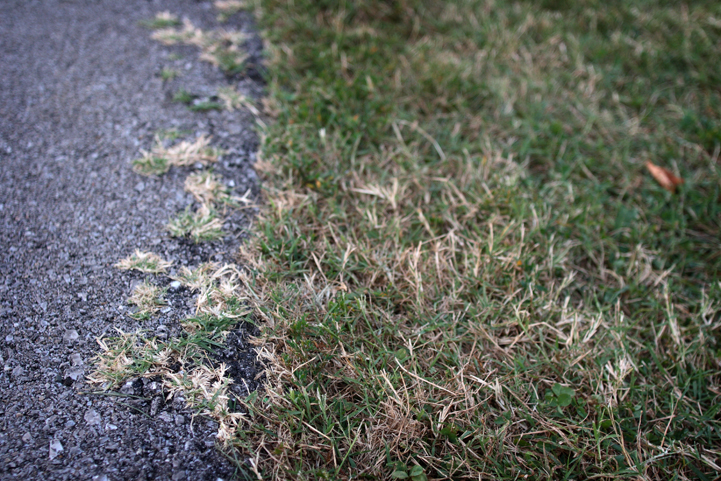
We often think that there are clear boundaries between nature and non-nature.  But look closely at the edge of this walkway--one bleeds into another, and the division isn't even static.  The grass keeps pushing and growing, and has to be beaten back by machines with spinning blades and such.  The battle to define and bound nature is endless, and violent.  No matter...the asphalt keeps cracking, and the grass will probably win out eventually.  Regardless, both are products of human intervention.

I am not going to say a lot about this one because if you look at it in a certain way it speaks for itself.  This is a clearly defined space for "being in nature."  Fascinating.  The concrete pad is the best part.  Sit here to view nature.


I am going to end with this one, which shows how intertwined humans are with the environments they produce.  These places reflect ideas about space and the so-called natural world, and they are also places full of memories.  Parks are often marked with memorials like this, so that new people who pass through can remember others who came before them.  Notice, once again, the role that the grass plays in all of this.  It not only frames the tree, it also rings the marker itself.  Gardeners have to work to maintain this aesthetic segregation.

Cross-Posted at Plurality Press.

March 12, 2011

Blogging archaeology: Photographs, locations, politics


Colleen Morgan over at Middle Savagery has a great new project going (already mentioned a few times here) called Blogging Archaeology, which is in anticipation of an upcoming session at this year's SAA meetings.  The link above highlights some of the responses to the first week's question: "Question 1: The emergence of the short form, or blog entry, is becoming a popular way to transmit a wide range of archaeological knowledge. What is the place of this conversation within academic, professional, and public discourse? Simply put, what can the short form do for archaeology?"   Definitely take the time to read through these posts, since there are some excellent, thoughtful responses.

So here's the question for this week:

"Blogging archaeology is often fraught with tensions that are sometimes not immediately apparent. Beyond the general problems that come with performing as a public intellectual, what risks do archaeologists take when they make themselves available to the public via blogging? What (if any) are the unexpected consequences of blogging? How do you choose what to share?"

For my answer I am going to focus on some of the dilemmas with posting photographs that can potentially reveal sensitive information.  I think Colleen's question for this week applies to both archaeology and anthropology in general, since choosing what to put online is always a critical issue (for academic, political, and even personal reasons).  It is definitely important to think about what's being posted, how it can be used, and what some of the potential impacts could be.

Monte Alban, Oaxaca, 2008

The photograph above was taken at a high profile site in Oaxaca, so it wasn't really an issue for me: people already know about this site.  But problems can come up when dealing with sites that are not publicly known (and protected).  While blogging is good for bringing about wider public understanding and knowledge about archaeology, there is good reason to think carefully about what we post.  I don't claim to have all of the answers, but I think about these questions all the time in the context of my own research and some of my past experiences.  Anthropology and archaeology can take us to some pretty amazing places, and it's a good thing to share these experiences with wider audiences.  At the same time, it's a good idea to at least think about what kinds of things should not be posted.  But it's not as if there is some clear cut line that makes everything simple.  Of course not.  Nothing is ever easy, is it?

When it comes to photographs (and naming specific locations), well, these issues always seem to be pretty difficult.  At some point we want to be able to talk about actual locations, rather than just vague regions.  Sometimes when everything is hidden there isn't much of the story left to tell.  So keeping everything anonymous certainly has its drawbacks, but there are also issues with letting people know where particular research sites exist (political reasons, etc).  As a general rule, I tend to be pretty conservative about the photographs that I post, especially those that relate to archaeological sites.  I worked on field projects while I was at SDSU and Palomar College in San Marcos, CA, and also worked on numerous CRM (cultural resource management) projects between 2004 and 2008.  Some of the projects were pretty amazing, and I always had my camera with me, but I didn't post all that much online, for some very specific reasons.  It's a fine line between bringing attention to an issue and making the location of a specific site known to broader audiences.  There were several sites that I worked on that either had sensitive material (burials, rock art, rock rings) or were in politically sensitive places (ie private property and so on).  Sometimes I will post photographs that show a general location, and provide a sense of the environment, but that don't really tell people where sites are specifically located, like this:

Anza-Borrego State Park, 2006.  This is where I spent most of the summer of 2006 working on a pretty massive CRM project.  Since we were out there in July and August, it was pretty hot (understatement).

Overall, though, I try to keep locations pretty vague when it comes to these kinds of archaeological sites.  But I would be interested to hear how some other folks deal with these kinds of issues.  How do you decide what to post, and what to leave out?  What kinds of issues (names, locations, politics, type of site, etc) do you take into consideration?  What kinds of methods do you use to give a sense of a site while still obscuring the location (I try to show landscapes that do not have specific landmarks that make the location easy to determine...sometimes you can show what a site looks like by providing a mid range shot that doesn't have a horizon).  In the end, these kinds of issues aren't exactly cut and dry, and there is never going to be one answer that works for all cases.  So it's a process that will always require thought and critical reflection.  When it comes to publishing and disseminating information, there are always going to be some risks.  It definitely helps to think through the issues at stake before posting online, rather than after.  Again, I'd be really interested to hear what others have to say about this.  I don't have all the answers, but considering my constant use of photography, I wish I did!

March 11, 2011

How could you possibly know what this is?


Kitchen-scape #1, February 2011.  That's all I'm saying.  And no, this doesn't have much to do with anthropology, unless you really want to stretch the boundaries.

February 26, 2011

Photographic Delusions

Seriously, I miss having an M6. And I miss having my Wisner 4x5, and that really good Rodenstock 210 that I used for about 10 years. I also miss my Rolleiflex, which was in really good shape. I miss my SL66 too. How on earth did I get rid of all those great cameras? Oh, that's right, I went back to school and became a poor anthropology grad student. These days I used a Canon 30D, which is OK, but not my favorite of all time. Ya, I have some other cameras at the moment (like a solid old Nifformat just in case), but the 30D is the one I use most of the time. It works, for now. But at some point I want some NEW STUFF, if you know what I mean. Why does everything that I need/want cost at least $1000 more than I have?

Something to consider: the famous photographer Edward Weston made some pretty amazing photographs with some P.O.S. lens he bought in a thrift store. Lesson: it doesn't take a Leica to make good photographs. So there you have it. Onward.

James Danziger on what we get from artists

James Danziger's blog The Year in Pictures is always full of all kinds of good stuff. Here is a snippet from his latest post:
And as I thought about this, I realized that one of the things artists give us is a way of defining and ordering what we see. A sea horizon can be a Meyerowitz or a Sugimoto. A random gesture in a park can be a Winogrand. A tackily colored interior can be an Eggleston. And rather than taking away from the pleasure of seeing these things, for those of us who are not artists I think it actually adds pleasure. Recognizing the association is in itself a creative gesture. Thus the realization that the scene outside my window (below) was like a Leong was both a gift from the artist and a gift from and to myself.
Photo by James Danziger, 2011.

February 16, 2011

Concepts = tools

Concepts are like tools, right? No...they ARE tools. I recently read a great chapter by the late Eric Wolf called "Contested Concepts," which provides an excellent discussion of some particularly critical tools in anthropology: culture, power, and ideology. A great read (but I have always been partial to Wolf)--and I think I need to reread it pretty soon, just for fun. Sometimes people talk about ditching one tool (culture) or another (ideology), but for me sometimes its more effective to trace the meanings of these concepts, understand how they have changed over time, and find ways of applying them in new, more refined ways. Rather than continually going to the hardware store (ie always creating neologisms for "new" concepts), sometimes it's not a bad idea if staple tools develop a well-worn patina from continual use and re-use. But then, I may be completely overdoing it with this analogy. This happens from time to time.

Speaking of tools, here's the documentary photographer's equivalent of a "critical tool":

Just when you thought I couldn't get Jim Marshall* and Eric Wolf into the same post, there it is. Take that, doubters! That's right, I just compared "culture" to a Leica. They each have their benefits and limits--and it's important to fully explore their possibilities before either jumping on the bandwagon or dismissing them outright. But that just my pure, unadulterated opinion right there.

Yes, I am supposed to be working right now...

*Image: That's Marshall's Leica M4, which certainly illustrates the fact that sometimes good tools can be used over and over again with consistent, yet innovative, results.

January 31, 2011

Favorites: Wright Morris


Wright Morris has always been one of my favorite photographers. The above photograph is probably the image that I like best of all his work--although he does have some great stuff. I really like the project he undertook in the 1940s, where he went back to a family farm and took a whole series of photographs of everyday things. Great work. His photographs are decidedly archaeological in some respects, and highly autobiographical. I really like his style quite a lot. You just can't beat the imagery of those old large format cameras. Read more about Morris, here.

January 23, 2011

Artifacts of violence #1


So then, what DO our artifacts say about us? We can read all sorts of things into, well, things. This was something that I found washed up on a beach in California a few years back. I used to have all sorts of these plastic army men when I was a kid, and I turned out relatively well. I think. Still, these types of objects do speak to particular social realities and conditions, don't they? When was the last time you walked through a kids' toy section? Notice any consistent themes? Any gender-based differences in the displays and products? I always find toy sections to be pretty fascinating places, especially when particular national debates crop up.

January 22, 2011

Images/Commodities/Memories/Objects/Events

Every time I go to a junk store, or antique store, or whatever you want to call a place where people buy old stuff for too much money, I am always drawn to the little boxes of photographs. Most of these types of stores have at least one place where there is a jumbled collection of old photos--from tintypes and glass plates (if you're lucky) to all kinds of images from the early 1900s up to around the 60s or 70s. Not many photos from the 80s...yet.

But, to get to some sort of point before I return to the reading that I am SUPPOSED to be doing, why on earth are we interested in looking and buying photographs of random people we don't know? What purpose does this fill? And could the photographer have ever imagined that their image would end up in such a place, so disconnected from the moment taking place in front of their camera? And what of the people in the pictures? Could they have ever guessed that the fragments of their lives would end up as generic, sentimental, nostalgic commodities on sale for tourists, passersby, and wayward anthropologists?

Upholding the social order through minute regulations and suggestions #1