Showing posts with label open access. Show all posts

July 10, 2012

Speaking of open access...


The subject of open access publishing gets a fair amount of press around here at Savage Minds. For good reason, in my opinion, because the publishing regime that we currently have needs a little…rethinking.  Going “open access” is, of course, one possible option.  But what is this open access thing really all about?  If we’re going to consider OA, it’s probably a good idea to look deeper into the issues involved.  It’s definitely not some magical thing that will just happen overnight.  It will take work, planning, and cooperation among lots of people.  Anyway, here are some sources to look  into regarding anthropology and open access:*

First, check out Peter Suber’s overview of OA for starters.  Learn it.  Live it.  Know it.

Next, Wikipedia (fittingly) has a pretty nice overview of what OA is all about, including some of the debates about financing, etc.  The OA page is here.

Also, check out the three interviews I did with Jason Baird Jackson about Open Access and anthropology a while back.  Jason is a wealth of information when it comes to all things OA (have a look at his site too).  The first of the OA interviews with Jason is here.

Financing is one issue that comes up a lot, and rightfully so.  For a few ideas, have a look at Kim and Mike Fortun’s “thought experiment” about Liberating Cultural Anthropology.

More good stuff: the OA archives link here at Savage Minds.  You don’t have to go far to start reading about OA.

Finally, I’m adding this simply because I can’t help myself:


*If you have other OA sources and links, please feel free to post them in the comments section.

January 31, 2012

Ed Carr on Publishing, peer review, and how "only the senior faculty can save us"

Who can save us...from ourselves?  Who can put an end to the current fiasco that is academic publishing?  Since we are all so entrenched in this system, where can we look for a way out?  In a post about some of the issues that academia faces when it comes to the current politics of publishing and peer review, geographer Ed Carr over at Open the Echo Chamber makes the case that escape and salvation from may lie in the hands of senior faculty.  Is he right?  He might be.

Carr starts off the post by expressing his concern that academia is using practices like peer review as a way to segregate itself from wider audiences.  He argues that peer review is, at heart, not a bad thing, since it provides a way of vetting ideas in an important way.  But, he writes:
the practice of peer review in contemporary academia has turned really problematic. Most respected journals are more expensive than ever, making access to them the near-sole province of academics with access to libraries willing to purchase such journals. The pressure to publish increases all the time, both in rising demands on individual researchers (my requirements for tenure were much tougher than most requirements from a generation before) and in terms of an ever-expanding academic community.
One of the deeper issues, Carr argues, is that peer review can be riddled with politics that end up "slowing the flow of innovative ideas into academia" because those ideas may "run contrary to previously-accepted ideas upon which many reviewers might have done their work."  Ultimately, Carr writes, these issues with peer review certainly don't do much to help with the public image of academia (although he is speaking more specifically to geographers here, this applies to academics in general).

Here's Carr's solution, or, at least, his ideas for a way to start digging out of this trench:
So, a modest proposal: senior colleagues of mine in Geography – yes, those of you who are full professors at the top of the profession, who have nothing to lose from a change in the status quo at this point – who will get together and identify a couple of open-access, very low-cost journals and more or less pronounce them valid (probably in part by blessing them with a few of your own papers to start). Don’t pick the ones that want to charge $1500 in publishing fees – those are absurd. But pick something different . . .
Again, although he is speaking directly to other geographers here, I think this proposal applies to and should resonate with the anthropological crowd as well.  For Carr, such a move would be a critical step for opening up academic publishing to wider possibilities, conversations, and collaborations.  I agree,nd I think he is right that certain established faculty members are in an important position for inciting and promoting change.  It's a matter of interest and desire.

At the same time, coming from the position of a graduate student, I can't help but wonder how those of us on, well, lower rungs of the academic ladder can do to actively foster these kinds of changes.  Since we are all encouraged to publish publish publish, maybe it would be a good idea to start thinking more strategically about how and why we are publishing, and more importantly WHO we decide to publish with.  If every graduate student and new professor is constantly upholding the current regime by basically giving up the fruits of their labor (and effectively providing certain publishers with a never-ending stream of valuable products), why WOULD anything change?  So, in the end, I think that Carr is definitely right, but that many of these changes are going to have to start taking place on multiple fronts as well.
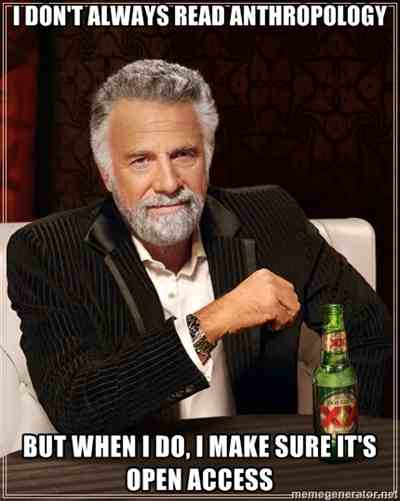
On that note, check this out.

January 11, 2012

John Hawks & Open Access News

From john hawks weblog:

"Today's NIH repository and the data access provisions of NSF grants were established by acts of Congress in the late 1990s. In my opinion, the agencies have in many areas gotten away with the bare minimum of compliance with these regulations. Worse, far from strengthening open access to publications and data, some in Congress want to reverse them. The current effort owes much to lobbying by academic publishers, and large campaign donations from officers and employees of those publishers to key Congressmen."

Read the rest here.

November 16, 2011

Interview with Jason Baird Jackson, Part 3

This is the last segment of this three part interview with Jason Baird Jackson about anthropology and open access. See Part 1 here, and Part 2, here.

Ryan Anderson: I think this last point you make about the direct role that faculty and graduate students play in all this is really important. We all have choices, and ultimately the publishing and communication system is what we make of it. So, as a last question for you, what advice do you have for people who are interested in these issues but unsure where to start looking for others who share similar concerns, values, and commitments?

Jason Baird Jackson: The open access community is by its very nature, open. In North American and European contexts, finding folks eager to help students and established scholars negotiate these questions is pretty easy. If one is at a university with a research- oriented library, there will be one or more librarians specializing in these issues. Such librarians often lead workshops on such topics as “author’s rights,” “copyright issues for scholars,” and “open access.” Librarians have a strong service ethic and are usually very eager to help scholars get their bearings on these topics. They are SO eager to find faculty allies on these questions. If you give them a moment, they will also passionately explain why OA matters so much to the future of the library and its public service mission...

Read the rest on Savage Minds.

November 14, 2011

Quote of the week: Jason Baird Jackson

"I have long cared about the serials crisis and now that the world is thinking more critically about student debt, I want us all to realize the direct relationship between the scholarly communications system, and the scholarly society system, and the neoliberalization of the American research university. Skyrocketing tuition is a consequence of public disinvestment in public universities like mine and yours. Leasing (we no longer purchase) toll access scholarship at ever higher costs from exceedingly profitable commercial firms (and their society partners) is not helping close the inequality gap in higher education. It is hardly the only factor involved (ex: think health care costs) but it is one of the few factors in which faculty and graduate students have a direct role to play—as authors, as disciplinary policy shapers, as peer-reviewers, as editors, etc. As contributors to the scholarly publishing system, we have choices available to us. We can make our work open in a number of ways and we can support and encourage those whose values and commitments align with our own."

-Jason Baird Jackson, here.


(just wanted to highlight this in case some of you missed it)

November 11, 2011

Anthropology & Open Access: An Interview with Jason Baird Jackson (Part 2 of 3)

See Part 1 of this interview here.

Ryan Anderson: So what are the major stumbling blocks holding up a transition to Open Access in your view? What's keeping most people from making this jump? Lastly, what do you think about the system employed by the Social Science Research Network (SSRN) where authors can post working papers? Can a system like that be a stepping stone to OA?

Jason Baird Jackson: At the author level, one stumbling block is a pervasive lack of basic knowledge about these issues among scholars and policy makers within our field (and in most fields). I am sympathetic to everyone’s plight. It is all very complicated and uncertain therefore doing what we have always done has proven the easiest path. Most of us do not understand copyright or the Creative Commons system. Most of us do not understand journal business models or how it is that librarians have made so much (expensive) information so easily available to those of us with the luxury of university affiliations. In the face of much confusion and anxiety, just sending our manuscripts to the editors and journals that we know in the way that we have always done has seemed sensible and prudent.

Related is the situation in which we perceive that we understand the changing landscape better than we do. A clear instance is when we post the final published versions of our writings online because we wrongly believe ourselves to have the right to do so. The increasing prevalence of such accidental piracy fosters the misunderstanding that such practices are the right way to do open access. Such piracy is counter-productive on many levels and is unnecessary given that there are legal and technically better ways to pursue OA.

Such author-centered issues are the major stumbling block for green OA. The fact that many scholars do not have direct access to a home institutional repository is another factor. I tried to suggest that there are usually workarounds for this in my earlier comments. Your mentioning of the Social Science Research Network represents another possible solution that anthropologists should investigate more actively [see Adam Leeds' comment about SSRN here on Savage Minds a while back]. I have not yet given it the attention that it deserves as a possible option for anthropologists.

The biggest factor driving green OA are funder and especially institutional OA mandates (touched upon above). Those who are most eager to promote OA in anthropology can work locally to establish mandates in their home institutions. When a university such as Kansas or California or a college such as Oberlin, or when (hypothetically) a research institute, applied anthropology agency or museum, establish a green OA mandate, this has the almost immediate effect of educating the entire research community at such an institution about the issues that we have been talking about, above and beyond the obvious direct benefit of bringing a large portion of that institution’s research output into the OA domain. Such mandates can be established at the school or department level in instances where an institution-wide mandate cannot yet be achieved. The most prominent and persistent advocate for green OA and for green OA mandates is cognitive scientist Steven Harnad, who makes the case consistently and forcefully, on the basis of much evidence, at his website Open Access Archivangelism.

Read the rest on Savage Minds, here.

November 7, 2011

Quote of the week: John Hawks

From John Hawks' latest post about publishing and open access:

"Seems to me that integrating online discussion into the academic literature would be done most simply by exploiting the system most widely used for citation tracking in the literature itself -- and that many blogs (including mine) already track. However, adding DOI to content turns out to involve an expensive membership to a cartel run by publishers."

 Read the rest, here.

Anthropology & Open Access: An Interview with Jason Baird Jackson (Savage Minds)

During the last few weeks I had the chance to conduct an email based interview with Jason Baird Jackson about Open Access (OA), academic publishing, and anthropology (cross-posted on Savage Minds)...

Ryan Anderson: Thanks for doing this interview, Jason. My first question is really basic: What IS open access all about, and how is it any different from standard academic publishing?

Jason Baird Jackson: Its a pleasure to have this chance to talk about open access (hereafter, OA). When I am asked to recommend an explanation of what OA is about, I usually point colleagues to the basic introductory documents assembled by philosopher and OA strategist Peter Suber. His one page "Very Brief Introduction to Open Access" is a great place to start. It begins noting: "Open-access (OA) literature is digital, online, free of charge, and free of most copyright and licensing restrictions. What makes it possible is the internet and the consent of the author or copyright-holder." There is much more that scholarly authors, societies, publishers, and libraries need to know about OA, but this is a good start. The features that Suber notes in this sentence comprise the basic differences that you are searching for.

OA evokes different things for different people and interest groups. I suspect that we will touch on some of the range of concerns that these actors bring to the topic. For a time, it made sense to speak of OA as an alternative to standard academic publishing but I do not think that this framing works any longer. While OA represents a significant set of transformations in what we might think of as the inherited scholarly publishing domain, OA is now at the heart of standard academic publishing. That does not mean that there is agreement about the issues or about emergent practices or even about the definition of basic terms. My "its all one system now" view just acknowledges such facts on the ground as the reality that we now have academic authors publishing in "gold OA" journals without even realizing that such a nameable kind of publication exists as such. On the other side of the ledger, the largest commercial publishers are fully, if sometimes begrudgingly, involved in open access through their having acceded to public, university, and funder demands for what is called "green OA" and via their author-pays approaches to gold and "hybrid” OA". (We'll touch on these modes, perhaps.) While people like me tend to talk about OA as a means towards a dramatic transformation of scholarly communication, one aimed at making it more sustainable, accountable, ethical, public, etc., commercial publishers increasingly describe OA as just another business model. We are debating and rebuilding the same publishing system even if, at times, and in some senses, it seems like OA advocates are creating an alternative infrastructure for the discovery, circulation, evaluation, and reuse of scholarly research outputs.

It can be treated as a different topic, one that we need only acknowledge and not discuss, but I just used the terribly clumsy phrase "research outputs" as a way of highlighting the parallel transformations that we are experiencing in the system of scholarly genres. Running alongside the OA transformation, the canonical genres—journal article and scholarly book—are being remixed and destabilized in countless ways. For anthropology, these generic changes are different from those that followed the field's "writing culture" debates. Earlier, we wondered what we could say in a book. Now we wonder what a book is. In your own corner of the new territory, I could ask: Is your anthropologies project a journal, a scholarly website, a weblog? Do your authors know? Such questions are increasingly present and point to what a time of experimentation we are in. OA advocates in anthropology have been particularly attentive to this related-but-not-the-same issue of genre. That said, the core of the OA discussion has been the journal article as we've known it and few would deny its continued centrality as the currency of the academic realm.

September 13, 2011

Barbara Fister on Tending the "Walled Gardens"

Here's the conclusion of Barbara Fister's recent piece "Where There is no Vision, We Publish and Perish."  The last three paragraphs are so good I had to include them all:
An old King James Bible line just came to me, which happens if you're old enough and were taught by nuns: “Where there is no vision, the people perish.” Turns out there’s another piece to that proverb that complicates the meaning a bit: “but he that keepeth the law, happy is he.” (Proverbs, 29:18) It doesn’t sound as classy in the NRSV: “Where there is no prophecy, the people cast off restraint, but happy are those who keep the law.” 

It seems to me the law we should follow is that old fashioned notion that the truth will set us free, and our job as scholars is to seek the truth and share it as widely as we can. We’re letting self-interest - in furthering our careers, boosting our institutional reputations, and protecting our disciplinary territory – divert us from that fundamental law. And I, for one, am not happy. 

It’ll cost money. It’ll take some serious work to hammer out the agreements, just as it took a lot of work for JSTOR to get publishers on board in the first place. But we need to do more for the world than tend our little walled gardens. We can do better. Where's that visionary thinking that started the whole thing? 
Take the time to read the rest, here.

Anthropology: Open Access & Academic Publishing Reading List

There have been a lot of recent posts and discussions about the state of affairs in academic publishing, and other important issues such as open access.  Here's a compilation of a few of the more recent posts:

Jason Baird Jackson:


Christopher Kelty:


Alex Golub:


Peter Suber:


George Monbiot:


Barbara Fister:


Lorenz:

September 12, 2011

Project Gutenberg

"Michael Hart, the inventor of the e-book and the founder of Project Gutenberg, passed away this week at his home in Urbana, Illinois. He was 64. Project Gutenberg has published an obituary, as have most major newspapers. That’s not surprising: his impact on the Internet and his vision of a future of open accessible content are profoundly important."

Read the rest, here.